








By Toby Fraser, organizer with the Masculinity Action Project in Philadelphia
Survivors are survivors. Believing this means recognizing that abuse impacts individuals no matter their background or who they are, and that all survivors deserve support and safety. That’s what I was told when I moved to Philadelphia in 2016 and started working at Lutheran Settlement House (LSH). LSH was the first agency I worked at with a dedicated Men’s Counselor and Advocate. While I have since moved on from the agency, the years I spent supervising the Men’s Counselor position taught me so much!
Yes, power imbalances exist in our society. Yes, overall, more men engage in violence and abuse than women. Yes, many advocates have a set stereotype of who they think a male survivor is, and it often only involves physical violence. Also yes, more men are able to recognize they are being abused when shown the Power and Control Wheel. Also yes, people are in relationships across the constellation of human experience, and unfortunately abuse can happen in any type of relationship. Not recognizing these things means we are often closing our minds (and often our doors) to so many survivors who are seeking our support.
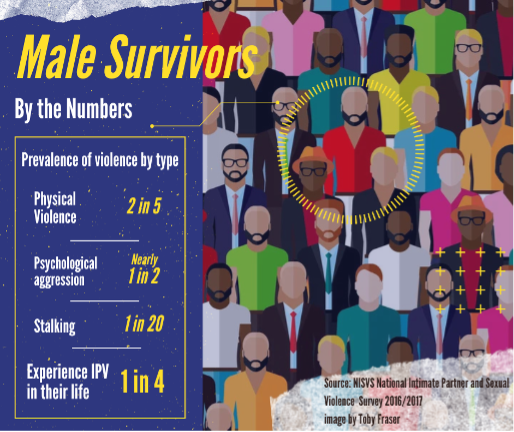
The truth is that 1 in 4 men in the United States experience contact sexual violence, physical violence, and/or stalking by an intimate partner at some point in their lifetime and also report an intimate partner violence-related impact such as being fearful, being concerned for safety, and needing medical care or help from law enforcement, among other impacts.
If you have read this far it is hopefully because you are looking to open your doors (and your mind) as wide as possible to embrace the idea that “survivors are survivors,” and that everyone who has been abused deserves your support. Keep reading to get concrete tips, guiding questions, and ideas for how to support male survivors – from before your first client reaches out to your program to debriefing with your supervisor after you close their file. While many of the strategies listed here will be more readily applicable to advocates offering direct services and advocacy at local agencies, the mindset shift and critical reflection encouraged in this piece can be helpful to the field as a whole.
Before you welcome male survivors into your program:
Just as in other aspects of our work, if we don’t address them, our internal biases and unconscious beliefs will show up, often in ways we don’t expect or wish. It’s time to do an honest check-in with yourself: when you think about a man being abused, what comes to mind? Did you think of a gay couple? A man being abused by a woman? As you notice who you think of initially, and then work to expand it, ask yourself a few more questions:
- Does being abused make someone weak? What if that “someone” is a man?
- What do you think it would take for a male survivor to feel safe again? How does that compare to what you think it would take for a woman to feel safe again?
- We are all individuals, who are also part of groups. And those groups make up our society. All of us carry those layers (individual, group, society) with us always. How easy or difficult is it for you to hold these different layers at the same time? To not get stuck seeing someone as an island unto themselves, or putting the fault for all of society's ills at the feet of one individual?
- For some, it is very challenging to set aside an understanding of men at a societal level to welcome in and believe the individual man who is seeking support from abuse.
- For others, it may be more difficult to see beyond the individual and reckon with how men and women are afforded different privileges at the societal level.
The goal is not to pretend that everyone has the same needs and experiences, but to notice your initial thoughts and feelings about male survivors. Check in on if any of them feel icky or might get in the way of your support for a male survivor.
As you delve into your thoughts and feelings, who is a person you can get support from to talk about them? Is it your supervisor? A colleague? Someone on the other side of an anonymous posting board? As long as you challenge yourself to learn and grow, there is no wrong place to turn for support.
Intake and assessment:
Let’s imagine that you are about to work with a client who identifies as a man. Maybe he called the hotline or walked in and requested an intake. Maybe it was a referral from an allied agency, or even a neighbor or family member who is asking for your help. However it happened, it is time to do an intake with this male survivor.
Before your first interaction, take a moment to breathe and consciously remind yourself of the "survivors are survivors" philosophy. Our first step with any client is doing an assessment to understand what support they are requesting, and what their relationship is like. Is it possible that you are feeling like you need to assess this particular client to make sure he is not the abusive partner trying to manipulate his way into services? Yes. That happens to all of us. Is it possible that he might feel your judgement or skepticism, and that those things could create additional barriers for his safety? Also, yes. The better we become at not assuming that being a man or a woman is what determines if they are abuser or abused, the more welcoming we become to all survivors and all types of relationships.
You do not need to ignore your feelings or judge yourself for having them. Stuffing them down will not help. As we did above, bring those feelings into the light to examine them. Use that awareness to build your toolbox of choices for how to deal with what comes up. If you find yourself unable to meet this survivor in good faith, you need to remove yourself from the case. If you cannot remove yourself, do your absolute best to find a part of yourself that believes this is a person who might be in an abusive relationship. Try to feed those feelings while you begin your intake.
Enough about us as advocates! What are we asking this guy for our assessment? Use any of the typical open-ended questions you would with any survivor:
- What brings you in today? How can we support you? What resources are you looking for?
Consider also digging into the relationship dynamics a bit more:
- What has changed in your relationship over time? Are you ever afraid of your partner? Can you say no to your partner?
As you listen, pay attention to:
 Red - contempt for their partner, using targeted misogynistic language, framing abuse as misplaced entitlement (“I deserve to be treated like a king, but I’m not getting it” vs “I want to be treated with love/kindness/care/compassion, but instead my partner is hurting/controlling me”)
- Yellow - masculine posturing that could be a fear of looking weak, struggling with questions about his safety (this could be masculine socialization getting in the way of admitting he feels unsafe, or it could be an abusive partner who feels safe and secure because he has the power), self-defense that feels like it may cross the line
- Green - expressions of fear of their partner, feeling uncertain about challenging their partner, anger at self for how they are “letting themselves be treated,” a clear pattern of his agency being minimized or being increasingly controlled
If you hear anything in the Red or Yellow section, make sure to consult a supervisor or other support person. First, see if they agree with your assessment. Then, if it is still Red, inform the client that your agency cannot provide support. If you have connection to a local men’s group or organization working with abusive partners, consider giving him a referral. If necessary, ask clarifying questions to move your assessment from Yellow to Red or Green, and decide next steps from there.
Again, it is ok to ask for help. Keep checking your own assumptions, share the intake narrative with another supervisor or colleague to see if you might be missing something. Do your best to minimize the impact of skepticism on the client. Remember the disproportionate cost of accepting a client into services and then needing to sever because they are the abusive partner versus denying services to a survivor because of our own biases. Our agencies can follow protocol to remove a client much more easily than a male survivor might be able to gather the courage to ask for help after being treated like a pariah.
Ongoing counseling and advocacy:
Once we are into the ongoing work with a male survivor, the session-to-session interactions are likely going to look similar to any other client. Do your typical empowering work. Continue checking your own biases along the way, we all have them. Look how far we are into this article, and I haven’t brought up children yet! Kudos to you if you noticed, and welcome to the club with me if you hadn’t thought of kids when thinking about a male survivor until now. What else might we be forgetting when it comes to male survivors?
Here are some other dynamics to be ready for, and specific questions or tips along the way.
1. Safety and support networks
- Has he tried to tell anyone else in his life about the abuse? What happened?
- Offer support to build a pod map to help identify who he can turn to for support. Be mindful of making sure those he turns to are safe and not going to share with his partner.
2. Family and housing
- Are there children involved and can he maintain a relationship with them safely? Are they being abused by his partner? What advocacy options or allied agencies are there if he needs to file for custody?
- If he is seeking shelter, do the shelters in your area truly accept male survivors?
- We know that most shelters are federally mandated to do so. We also know that all too often there are imposed space restrictions and informal practices that can make it even more difficult to get a man into shelter. As always, continue to advocate for this client as you would any other if you are faced with barriers while safety planning.
- Are any of your own biases coming up around other housing or other safety planning options? Would you hesitate to ask if he could move back with his parents because of subconscious beliefs about men being independent? What feelings come up if you think about him seeking to evict his female partner from an apartment in his name versus if the roles were reversed? On the flip side, are there potentially more housing options because he may be in a better position than other clients due to having more stable employment or higher pay (as men do at a societal level)?
3. Emotional support and safety planning
We may not need to tell you this, but often men are not great at accessing their emotions. This is more often from lack of skill than a lack of interest in processing.
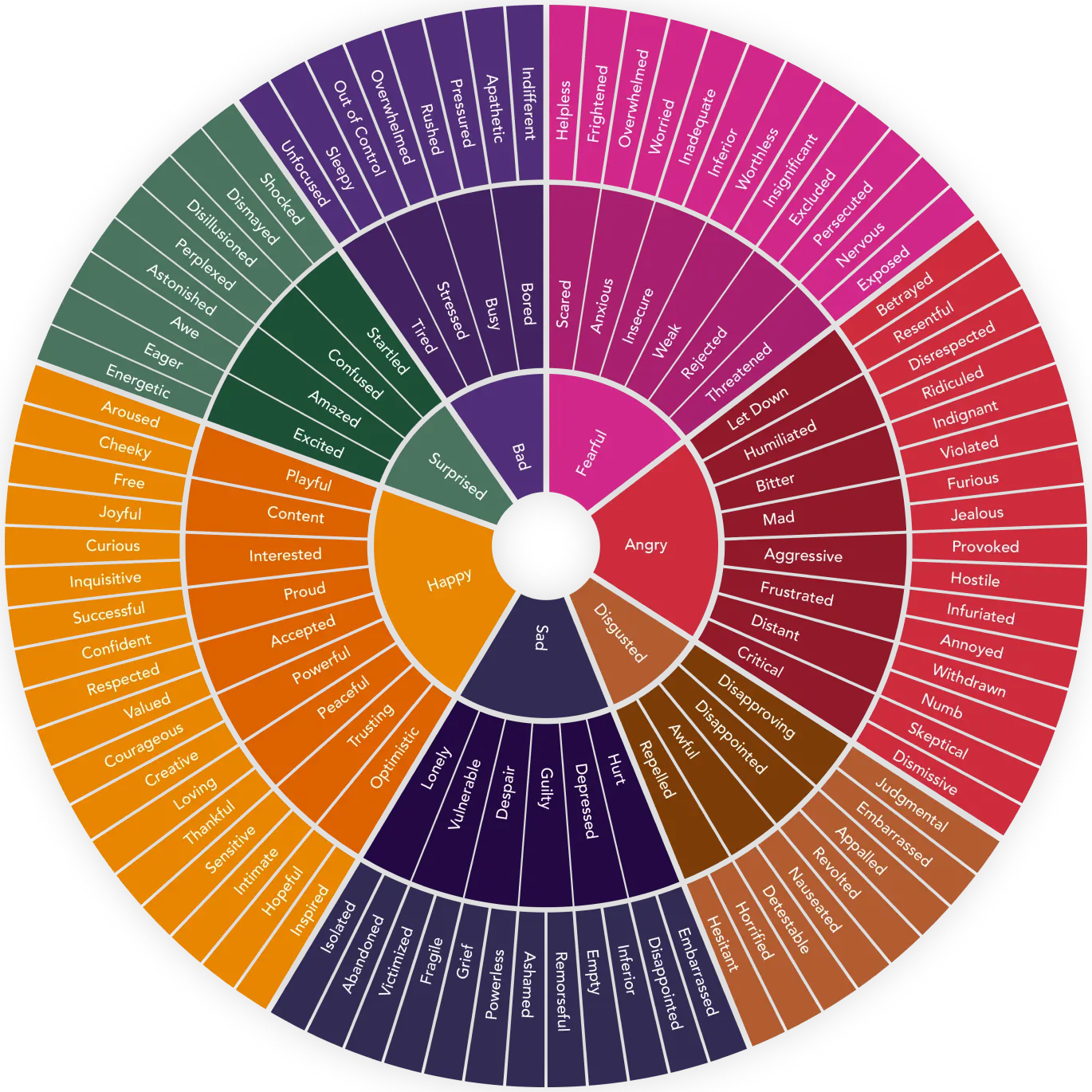
- By using tools like the Feelings Wheel, and modeling the use of feeling words, advocates can support men to build their emotional intelligence.
Our empowerment counseling and advocacy with male survivors is much like how we support any other client. It can be helpful to take a breath and remind yourself that things don’t have to change all that much. Survivors are survivors after all.
Closing out and debriefing:
You made it! You worked on yourself (as needed) to be open and accepting of a potential male survivor. A man approached you/your agency for support, and you successfully assessed the situation and were able to bring this person in as a new client. You then completed your 10 sessions (or whatever you do) of counseling and you’ve closed him out as an individual client. Now what?
Groups and ongoing support for this client
- If your agency offers group support, are you and your colleagues ready to have one group for all survivors? Do you have enough male clients to have a men’s group?
- In my experience, it was often the staff who held more rigid beliefs about keeping the groups separate. Clients often showed us how ready they were to welcome all survivors into shared space.
- If you have other ongoing support or resources for clients, are those agencies or programs able to help a male survivor? Is there any advocacy you can do to ensure that your client is met with care and not suspicion at his next stop?
Debriefing and supervision
- As you normally would, seek out support to debrief your work with this client. What did you learn from this process? What did you do that seemed to “work” to support this client that you want to make sure to do in the future? Are there things you would do differently next time?
As a man in this field, it may be that I had an easier time working with male survivors. I believe that I came around to this viewpoint not because of nature, but because of the nurturing environments I’ve worked in in this movement. I hope that if you felt challenged by this piece, it was the good kind of challenge that leads to deep questions and eventual growth. I hope even more that you read this and saw yourself in the “what to-dos,” that you are already a supportive person for all of the survivors that you encounter. Either way, I hope that you will continue to push yourself to do all you can for the survivors you support until our prevention teams create a world where violence is unimaginable.
For more information:
Special Collection: Centering the Needs of Male-Identified Survivors of Domestic Violence