








By Toby Fraser, organizer with the Masculinity Action Project in Philadelphia
Take a moment. Think back to why you started doing this work. Maybe you experienced abuse yourself or watched someone you love navigate it. Maybe it started as a job and became a calling. Whatever brought you here, something about this work matters deeply to you. It’s probably something about believing survivors, about empowerment, about the idea that no one should have to suffer abuse alone.
As you remember your why, think about your agency. Think about the experience a survivor has when they connect with you – from the first time they see your agency’s name somewhere, the moment they decide to reach out, who they encounter when they do, and what the process and next steps are to get connected. Stay honest about the good parts and the hard parts. How do you think it feels for a survivor to begin receiving services from your agency?
How does it feel if you imagine that survivor is a man? Do you imagine his experience connecting with your agency lives up to your reason for being in this work? I hope so.
For many agencies, if we are honest, the answer is not always yes. Not because we don’t care but because care alone doesn’t build systems that work for everyone. Systems are built through intentional choices: the words we put on our website, the policies we write, the referral relationships we cultivate, and the habits we’ve never stopped to notice. This piece is an invitation to examine those things. It’s not about blame; this is about getting back to our roots of supporting survivors. And right now, there are male survivors who aren’t getting our help.
If you read What Practical Tools Do Advocates Need to Offer Effective Support to Male Survivors?, you might have noticed the focus on internal work. That work remains key to how we support male survivors. But the most self-aware advocate in the world, working inside a system that signals male survivors don’t belong, can only do so much. We need to look at our agencies as a whole, not just ourselves.
What’s in a name?
Let’s get this out of the way up top – names do matter, but actions matter more. Many advocates at agencies with names such as Women’s Center and Women Against Abuse may feel an uncomfortable tension when thinking about serving male survivors. Many board members and leaders feel a tension about changing those names – they carry history, community trust, and often donor relationships built over decades. Changing an agency name is a significant undertaking that requires broad organizational will, and it is not something any one advocate can or should do alone. But a name change is not the end-all be-all of supporting male survivors.
Exclusionary language doesn’t just exist in names, it can show up everywhere. Research suggests that the language we use to describe abuse shapes whether or not male survivors recognize themselves in our services. Terms like “domestic violence” and “victim” may not resonate with many men’s experience of abuse. More neutral language such as “domestic abuse,” “partner abuse,” “relationship boundary crossing,” or “survivor” has been found to help men feel more comfortable identifying and disclosing what is happening to them.
If your agency’s name is not going to change, there are meaningful things you can do right now:
- Add explicit language to your website and intake materials stating that you welcome men and all survivors.
- Review the language throughout your materials. Not just the name, but every label and descriptor. Have an eye toward who it includes and who it might leave out. Consider if you can shift some instances of “domestic violence” to more action-oriented phrases like “boundary crossing” or “verbal abuse.”
- Brief your hotline staff and intake advocates to actively affirm male callers: “Our services are open to everyone, and I’m glad you called.”
- Work with your communications team to ensure photos, names and stories in your materials reflect the wide range of survivors you serve, even if that’s aspirational at first. For example, use traditionally male names in some stories, more generic nature photos instead of flowers, and a broad range of colors across posts and materials.
- In community trainings and presentations, say out loud that you support male survivors.
- If you feel called to work on a name, or other language change, strike a balance with being specific and general. Saying “we support all survivors” can sound helpful, but men may still not see themselves in that statement. Make sure that across all of your materials you are using a mix of language to name women, men, all survivors, and other ways to helping everyone see themselves in your messaging.
The proof is on the paper
Pull out your agency’s policies and read them with this question in mind: is there anything here that explicitly includes or excludes male survivors?
Sometimes the exclusion is explicit, like a policy that defines clients as “women and children.” This may have made sense when it was first written but now, it practically closes off services to male survivors entirely. Sometimes it is implicit, like a shelter policy that never addresses male survivors at all, leaving staff without guidance when a man shows up needing emergency housing.
 The goal of a policy review is not to tear everything down and rebuild from scratch. It is to find the gaps between your values and your written commitments, and to start closing them. Some questions to guide you:
- Does your eligibility language include all survivors, or does it implicitly or explicitly limit services to women and children?
- If you run a shelter, what do the policies state about male survivors?
- Does your intake and assessment policy include guidance specific to working with male survivors?
- Do your confidentiality and safety planning policies account for the specific risks male survivors may face, including the risk of being disbelieved or misidentified as the perpetrator?
Walking the talk
Anyone who has worked in a social services organization knows that what is written in a policy and what actually happens are not always the same thing. This gap is where we lose male survivors.
Maybe the policy says all survivors are welcome. But the intake form has checkboxes for “female” and “male,” and the intake advocate has never been trained on working with a male client. Maybe the support group is technically open to everyone, but no one has thought about what it would mean to have a male survivor join the group.
Research has found that male survivors often face skepticism from professionals when they disclose abuse, and that this skepticism is a significant barrier to future help-seeking. But the same research also found that even when a man did not disclose at the moment of crisis, a single positive interaction with a professional influenced his decision to disclose at a later date. Every interaction is a potential turning point. The way we treat people matters, survivors or not (yet known), and it starts with genuinely believing that anyone walking through our door could be one.
If you are reading this and seeing yourself or your agency, don’t fret. Awareness is the first step, and once you see these issues they become solvable. To help build your awareness of potentially harmful practices ask:
- When did we last serve a male survivor? What was that experience like – for him and for us?
- What would happen right now, in practice, if a man called our hotline or walked in the door? Walk through it step by step.
- Where do we feel uncertain or underprepared? Is it about clinical skill? About physical space? About how we think our existing clients might respond?
- Do we have male staff members? In what staff positions? Do they work with survivors?
Some of what you find will be bias that needs to be named and worked through, ideally in community with other advocates also working through their biases. Some of it will be anxiety about change that dissolves once we take the first step. Some of it will be genuine logistical questions that require real problem-solving. And some of it will be habits that need to shift. All of this will take practice, missteps, awkward conversations, and course corrections before we get somewhere new.
Getting the word out
It is not worth making all of these changes if we don’t tell people. Think about every way someone in your community might learn your agency exists – an internet search, a hospital flyer, a hotline referral, a friend’s recommendation, a conversation with a school counselor, pastor or coach.
Now ask: do those people and places know that your agency support male survivors?
Start with your own materials. Look at your website with fresh eyes. Who is pictured? What pronouns and language are used? If a man found you while in crisis at 2 a.m., would he conclude your agency was for him? Then move outward. When you train allied professionals, do you tell them explicitly that you serve men? Do the agencies that refer to you know to send men your way? The myth that men cannot be abused is so common that if we are not explicitly dispelling it with our partners, they are likely reinforcing it with their limited referrals.
The best services in the world only work if the people who need them can find them. For male survivors, who already face stigma and skepticism that can make help-seeking feel impossible, your visibility as a welcoming resource matters.
A note on separation
One pattern worth naming: some agencies, in good faith, respond to the perceived challenge of serving male survivors by creating entirely separate, parallel programs. Hotel stays instead of shelter. Individual advocacy only, no groups. Always referring men to other agencies.
The impulse is understandable as there are real questions about how to integrate services in ways that are safe and trauma-informed for all clients. But be honest about the tradeoffs. Separate services can deepen isolation for male survivors, who often already feel like they don’t belong anywhere. They can also signal, unintentionally, that male survivors are a problem to be managed rather than a population your agency genuinely serves.
 In conclusion: Letting our values lead us
Come back to where we started. You are in this work because you believe survivors deserve support and safety. Hold that belief up against the experience a male survivor has when he connects with your agency. If there’s a gap between the two, you now have a map. The goal is not a perfect agency. The goal is one that keeps moving toward the values that brought all of us here in the first place.
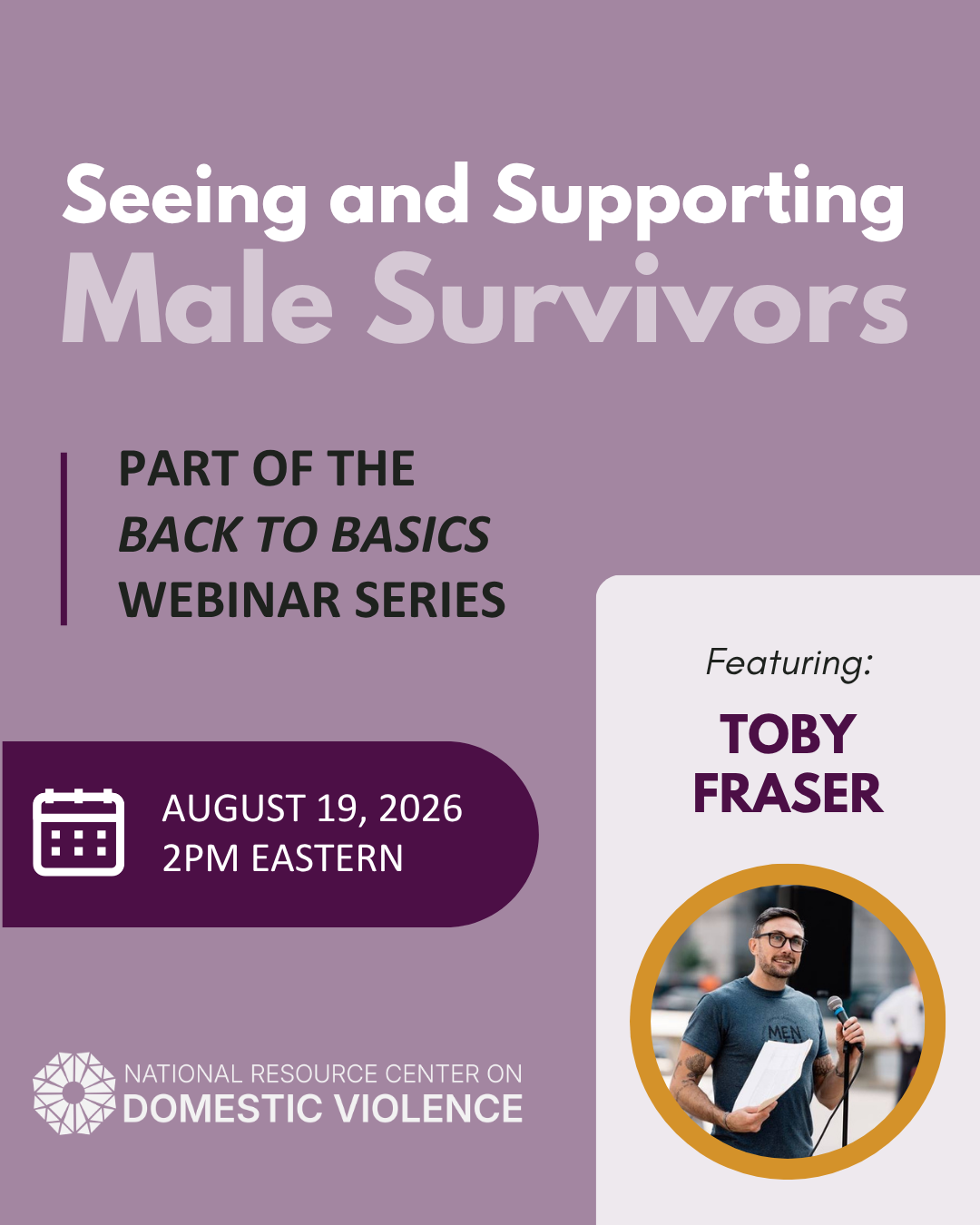
For more information: Register now! Back to Basics: Seeing and Supporting Male Survivors